
When businesses grow, their processes don’t always grow with them.
A perspective shaped by working inside operations and process-driven environments.
Many growing businesses reach a point where the way work used to flow no longer works as smoothly as it once did. Processes that were once manageable become scattered across tools, spreadsheets, and manual follow-ups.
That’s where structure begins to matter.
What I learned working inside operations
As someone who has worked in operations, recruitment pipelines, and process-driven environments, I’ve seen how quickly growth can outpace structure. Deadlines multiply. Follow-ups slip. Processes become reactive instead of intentional.
What I learned from that experience is simple: most businesses don’t struggle because they lack effort. They struggle because their infrastructure hasn’t caught up with their ambition.
When systems remain informal while a business grows, even capable teams end up spending more time chasing tasks than moving work forward.
My experience working in operations and process-driven environments shaped the system design philosophy behind CoreAxis.
The CoreAxis Philosophy
Understand the operation first
Every system we design begins with understanding how your business actually operates.
Structure before automation
Instead of layering new tools, we first design the underlying workflow.
Clarity over complexity
The goal isn’t more tools. It’s operational clarity.

Our Approach
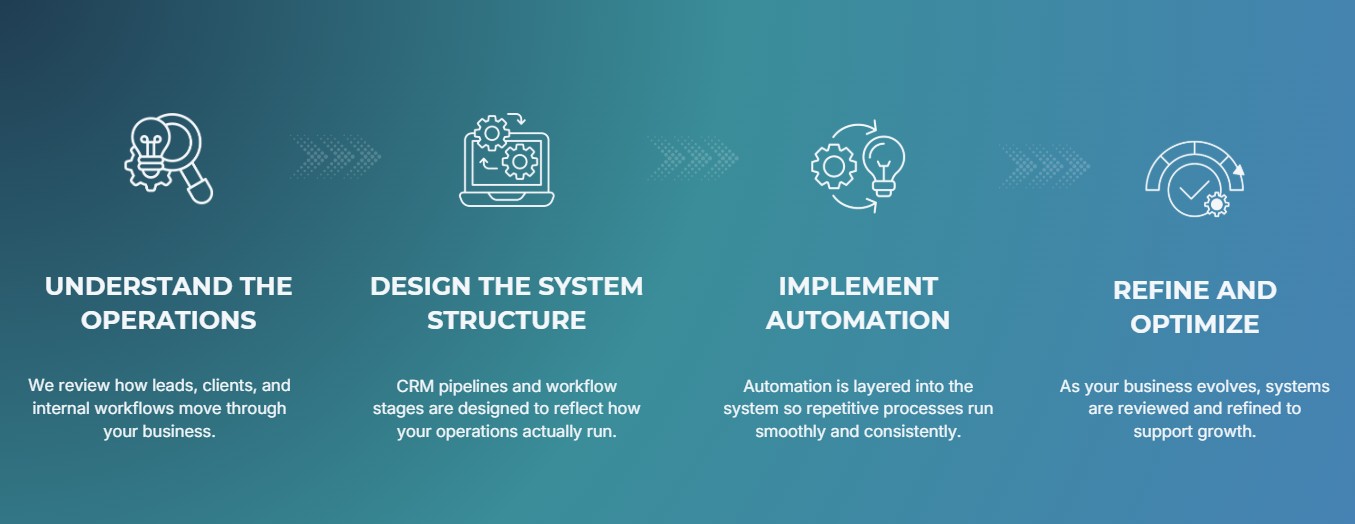
The CoreAxis System Design Process
Behind CoreAxis

I founded CoreAxis after working in operations and process-driven environments where systems, workflows, and coordination play a critical role in how businesses function day to day.
Through that experience, I saw how quickly growth can outpace structure when processes remain informal. CoreAxis was created to help businesses design systems that bring clarity, visibility, and flow to their operations.
The CoreAxis Mission
To design structured CRM and automation systems that give service-based businesses the clarity and control they need to grow.
Structure Creates Better Operations
When operations are structured properly, teams spend less time reacting and more time focusing on meaningful work.
CoreAxis exists to design the systems that make that possible.
Ready to replace scattered processes with structured systems?


